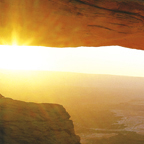
First and Foremost; This is a scenic calendar of the region in and around The Colorado Plateau. The majority of the images will be taken in the states of Arizona, Colorado, New Mexico, and Utah. In other words “the four corners area”. Monument Valley, on Navajo Lands, is fairly typical of the landscape in the "four corners". We do not want to limit the images in the calendar to only "red rock" areas. The Colorado Plateau, even in its semi-official boundaries, has more diverse landscapes than in any other region of the United States. Not only do we consider all of Arizona, Colorado, New Mexico and Utah valid in any definition of this region but also eastern Nevada, southern Idaho and western Wyoming.
View a map with the boundary of the Colorado Plateau delineated. “Map of Colorado Plateau”
Second; The calendar is a travel guide. Travelers who wish to explore this region will benefit from a series of three captions or lines below each monthly image that provide a wide range of site specific information. With this information the traveler can visit the exact location in the photographs.
The first caption briefly describes the primary focal point in the image - for example “Horseshoe Bend of the Colorado River,” “Bow Tie Arch”, or “The Grand Canyon”. Most calendars do not go beyond this description other than to provide the photographer's or photographic agency's name.
The second caption describes the direction of view, additional information on the location, the state, and the land ownership or land stewardship agency. If you are interested in maps, orienteering or photography you should want to know in what direction the image is taken. If you are planning to visit you need to know what agency is in charge of overseeing the area. Knowing who has stewardship responsibilities will determine the type of access available to you.
National Parks and Monuments are much more restrictive in terms of access to camping, backpacking, hiking, and biking - typically restricting activity to designated areas and trails.
U.S. Forest Service lands are a mix of more restricted and less restricted areas depending on volumn of use, typically restricting activity to existing areas and trails.
BLM lands are much less restrictive typically allowing camping anywhere and cross-country travel on foot anywhere.
Wilderness Areas and Wilderness Study Areas typically restrict travel to foot traffic only but do not require that you to stay on trails. In fact you are encouraged to hike cross-country in Wilderness Areas.
All areas typically restrict vehicular travel to existing roads. Many of the roads in these areas are unpaved and unsuitable for standard automobile traffic. Our opinion is that the best adventures will be found on unpaved roads. Many of the images in the calendar are taken from unpaved backroads.
The third caption provides the latitude, longitude, and elevation above sea level from the position of the camera. If you have a GPS unit you can load the coordinates from the caption and follow the pointer to the exact location the image was taken. If you own one of the retail computer mapping programs you can also load the coordinates and see exactly where the image was taken on a map. If you have a USGS quad of the area you can interpolate from the hard copy and determine the location. We use a Garmin etrex Vista to generate the coordinates and I cross check with Delorme’s Topo USA. If you are into geocaching you could consider this similar to tracking a cache, however, instead of a cache you are rewarded with a great view.
The third caption also provides a brief description of the road conditions and vehicle that in our opinion is required to access the site. If a hike is required the one-way distance is described and the difficulty rated.
Obviously, these opinions and ratings are our own and will not apply to every vehicle or human being on the planet.
Third; The calendar provides the establishment dates of all National Parks and Monuments west of the 100th meridian. The 100th meridian is considered the official demarcation between the eastern and western United States. This determination is based on yearly rainfall. East of the 100th meridian the land receives more than 20 inches of rainfall per year - west of the 100th meridian the land receives less than 20 inches of rainfall per year. The 100th meridian runs north to south thru the country from approximately the western third point of Kansas (i.e. west of Hays, KS). The establishment dates are included because the National Park System and to a lesser extent the BLM are charged with preserving and making available to the public some of the most impressive landscapes in the world. These landscapes are maintained in the form of parks and monuments and we certainly appreciate our governments protection and stewardship. If you think the rest of the world does not appreciate these places you would be seriously mistaken. Any visit to the National Parks on the Colorado Plateau will demonstrate that travelers from every country in the world routinely visit these very rare landscapes. Please support the The National Parks, Monuments, Forests, and all public lands.
Fourth; The calendar covers thirteen (13) months providing a January of the following year because we believe it makes a more user-friendly calendar. Before producing this calendar we purchased a thirteen-month calendar not knowing the format at the time and found it very convienient. The last thing you want to think about on New Years Day is changing calendars. To clarify this issue further, the physical process of printing on an offset press forces two extra pages into the calendar. As a result most designers simply generate a sixteen-month calendar that takes up the space on both of the extra pages. Some produce a sixteen month calendar and compile some type of text to consume both extra pages. We have opted to use the extra pages to provide an additional image and month that extends into the next year.
The following abbreviations are used in the calendar in reference to parks and monuments:
| N.P. | National Park |
| N.M. | National Monument |
| N.H.P. | National Historic Park |
| N.H.S. | National Historic Site |
| N.Pres. | National Preserve |
| N.Rs. | National Reserve |
| N.S. | National Seashore |
| N.Volcanic.M. | National Volcanic Monument |